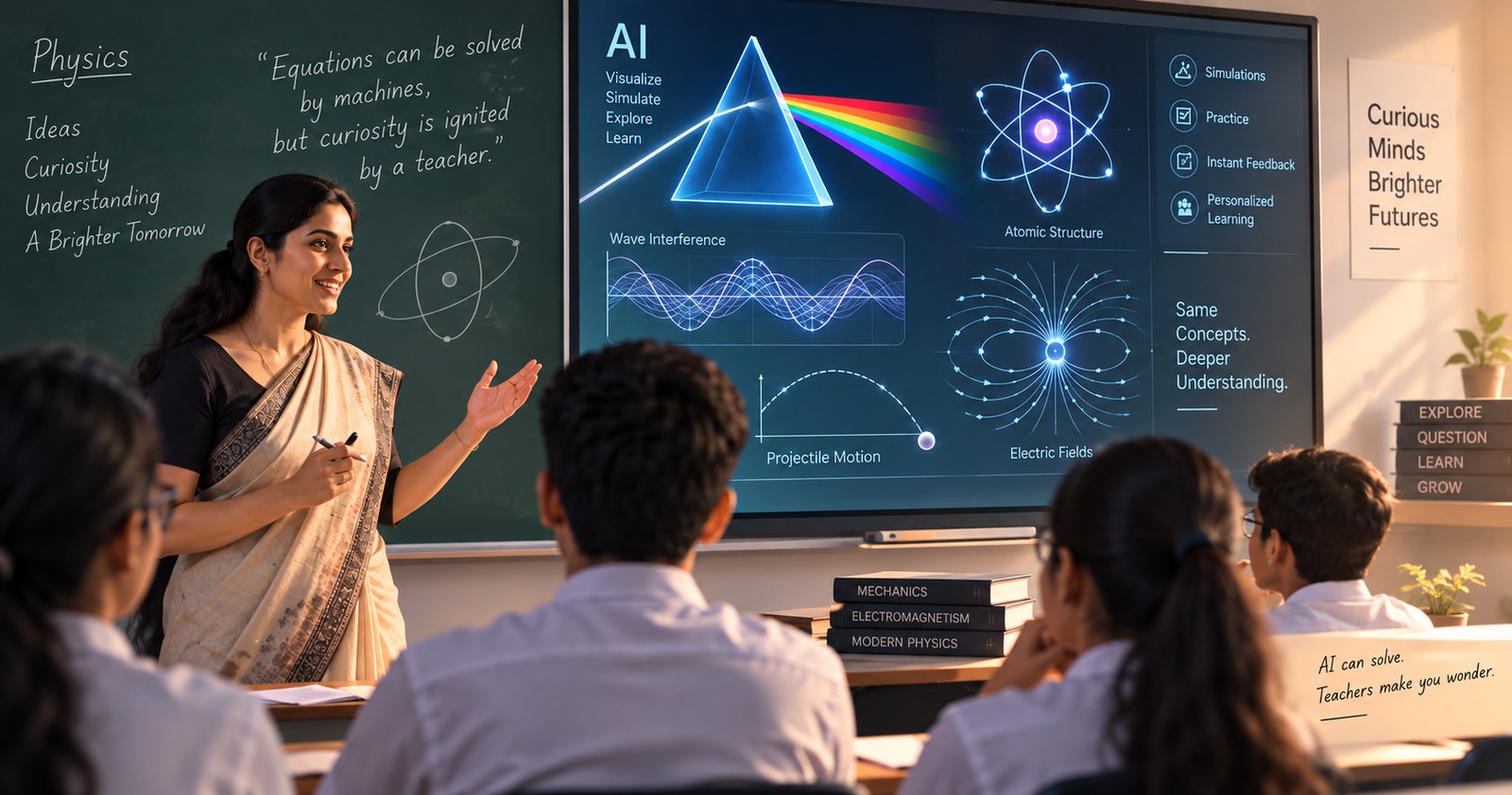
A guest post. This essay was written by my wife, Neha, who teaches Physics to Classes XI and XII. It was selected for her school’s Teachers’ Day special, on the theme “Mentorship in the Machine Age: how will AI transform the way we learn and teach?” She doesn’t keep a site of her own, so it lives here.
“Equations can be solved by machines, but curiosity is ignited by a teacher.”
As a Physics teacher of classes XI and XII, I witness every day that learning is not merely about formulas, derivations, or numerical accuracy — it is about conceptual awakening. Artificial Intelligence is entering our classrooms with great speed, and from my perspective, it is not a rival to teachers but a powerful new instrument, much like a well-calibrated laboratory apparatus.
In senior secondary Physics, students often struggle not because the formula is difficult, but because the concept behind it is invisible. AI can simulate electric fields, visualize wave interference, or model projectile motion in ways that chalk and board alone cannot. Complex ideas like quantum behavior or electromagnetic induction can be animated, paused, and replayed until clarity emerges. In this way, AI can deepen understanding and reduce fear of the subject.
Yet Physics is also a subject where misconceptions matter. A machine can identify that a numerical answer is wrong, but only a teacher can diagnose the misconception — whether the student confused direction with magnitude, sign convention with value, or memorized a formula without understanding its origin. As teachers, we read hesitation in a student’s eyes before they even raise a doubt. We know when a silence hides confusion.
Alertness and focus in a Physics classroom are driven by human energy. A teacher’s enthusiasm during a derivation, a sudden real-life analogy, or a simple question asked at the right moment can trigger excitement and release motivation — those “happy hormones” that make learning stick. AI can provide accuracy; teachers provide momentum.
For Classes XI and XII, teaching Physics is also about emotional guidance. Board exams, competitive pressures like JEE and NEET, and fear of failure weigh heavily on students. AI cannot sense anxiety or rebuild confidence after repeated mistakes. A teacher, however, can reassure a student that one wrong step does not mean a wrong future.
In the coming years, the classroom will evolve into a hybrid space. AI will handle simulations, adaptive practice, and data analysis, while teachers will focus on reasoning, doubt-clearing, and mentoring. Just as a calculator did not eliminate mathematicians, AI will not eliminate teachers — it will refine their role.
In conclusion, from a Physics teacher’s perspective, AI is like an advanced instrument in the lab — precise, powerful, and essential. But the teacher remains the scientist who designs the experiment, asks the right questions, and inspires students to look beyond the equation and understand the universe itself.